2026
Apr
01
Desk-work headaches and neck tension: underlying causes and dry head spa for mental fatigue

“My temples throb by evening.”
“The base of my neck feels heavy and I cannot think clearly.”
“I have pain behind my eyes, and looking at a screen is uncomfortable.”
Anyone with a desk job may have experienced these discomforts.
These headaches and neck tension may be more than simple stiffness: a sign of an overworked mind.
Stretching or painkillers may help temporarily, but leaving underlying factors unaddressed can make the problem persistent.
This article explains desk-work headaches and neck tension, the limits of self-care and professional ways to reset.
Three ways desk work can create persistent headaches
Cause 1: the invisible load of forward-head posture
The head weighs around 5–6 kg, about as much as a bowling ball.
With good posture, the skeleton supports it. But leaning forwards at a computer can make the neck load two to three times greater.
At 15 degrees forwards, the load is around 12 kg. At a 45-degree phone-viewing angle, around 22 kg: like carrying a primary-school child on the neck continuously.
To support this, the following muscles stay tense.
- Trapezius: the large muscle from neck to back, involved in the raised-shoulder posture
- suboccipital muscles: small muscles directly below the skull, overworked when staring at a screen
- Temporalis: muscles around the temples, linked with squeezing headaches from stress or clenching
Continual contraction compresses blood vessels, reduces oxygen and releases pain-related substances, producing a dull, band-like squeezing around the head: a tension-type headache.
Cause 2: tired eyes and the trigeminal nerve
Long screen sessions overwork the eye’s ciliary muscles as they focus.
This fatigue is transmitted to the brain through the trigeminal nerve, which carries facial sensation, and can contribute to headache. The neural connection explains why tired eyes and headaches often coincide.
Blue light also keeps the brain alert, sustaining excessive sympathetic activity for long periods. Tension remains into evening, and fatigue may hit after leaving work.
Cause 3: mental fatigue from prolonged concentration
Another often-overlooked factor in desk-work headache is mental fatigue.
Computer work keeps particular brain regions, especially the frontal lobe, busy. Preparing slides, composing emails and analysing figures create cognitive load that further amplifies muscle tension.
A tired mind can lead to unconscious jaw clenching or raised shoulders, creating thinking → bodily tension → worse headache → poorer concentration as a vicious cycle.
Stretching alone may not be enough
Many articles recommend stretching and posture for desk-work headache. These matter, but they do not resolve every case.
Deep suboccipital muscles are difficult to reach yourself
At the base of the neck, the suboccipital muscles connect the skull with the first and second cervical vertebrae. Working with eye movement, they accumulate strain during computer use, but surface stretching may not relax them enough.
Releasing tension in these deep muscles requires techniques that apply pressure directly at the right angle and intensity.
Risks of relying too heavily on painkillers
Do you take painkillers whenever a headache starts?
Using painkillers on 10 or more days a month can raise the risk of medication-overuse headache. Even if medicine reduces pain, the underlying muscle tension and mental fatigue can remain. Alongside symptom relief, the tension itself needs attention.
Is your autonomic on–off switch stuck?
Prolonged sympathetic dominance at work can mean that even afterwards, fight mode does not switch off.
If baths do not relax you and sleep does not restore you, the switch may not be working smoothly. Beyond relaxing muscles, an approach that acts directly on the nervous system may be needed.
Three reasons desk workers choose dry head spa
1. Relaxing fascia around the skull and encouraging circulation
Dry head spa uses hands-on care for the epicranial aponeurosis, the temporalis muscles around the temples, and the suboccipital muscles.
When stiff fascia relaxes, pressure on blood vessels is relieved and blood flow to the brain improves. Feeling a lighter head and clearer vision after treatment reflects this restored circulation.
2. Encouraging relaxation and switching the busy mind off
Hands-on techniques using steady rhythm and suitable pressure strongly support a switch to parasympathetic activity.
Eyes closed in a dark, quiet space, you leave care to professional hands. A break from incoming information lets an over-tense nervous system move into recovery mode. Naturally falling asleep during treatment reflects that change.
3. Clearer thinking the following day
Resting a tired mind can bring changes you notice at work the next day.
- Concentration lasts through the morning
- Email wording comes more easily
- No headache by evening
More than simple comfort, this reflects restored mental performance. For desk workers, dry head spa can be strategic rest.

Desk-work headache self-care to start today
Alongside professional care, try these daily habits.
1. Protect eyes with the 20-20-20 rule
Every 20 minutes, look 20 feet (6 metres) away for 20 seconds: a simple rule recommended by eye-care professionals, giving focusing muscles regular breaks and reducing accumulated eye fatigue.
2. Gently lift at the back hairline to ease the neck base
Use thumb and index finger to gently lift and slowly draw the tissue around the back hairline. Hold five seconds, five times. This works on the surface tissues over the suboccipital muscles and can ease a heavy head.
3. Look up towards the ceiling once an hour
Reverse the forward posture: slowly look up and hold five seconds. This stretches the front neck and relieves cervical load. It can be done seated between meetings.
Frequently asked questions
Q. Does dry head spa help desk-work headaches?
A. Yes, particularly for tension-type headaches. It directly relaxes tension in the temporalis and suboccipital muscles—a main cause of headache—and improves blood flow to the brain. We especially encourage those who cannot do without headache medicine to try it once.
Q. Can I come after work in a suit?
A. Of course. No water or oil is used, so a suit or office-casual clothing is fine. Five minutes from Nagoya Station, we are easy to visit after work and open until 21:00 on weekdays.
Q. How often do you recommend?
A. For desk workers, every two to three weeks is a guide. For persistent headache, start every two weeks in the first month, then switch to monthly maintenance as things ease.
Q. What about migraine?
A. Avoid treatment during a migraine attack, although preventive care may offer benefits. Regular care for neck and shoulder tension, which may trigger migraine, helps some people experience fewer attacks. Ask during consultation if concerned.
About HITOYASUMI
Have you accepted desk-work headaches and neck tension as unavoidable? Reset mind and muscles with professional hands and reclaim pain-free everyday life.
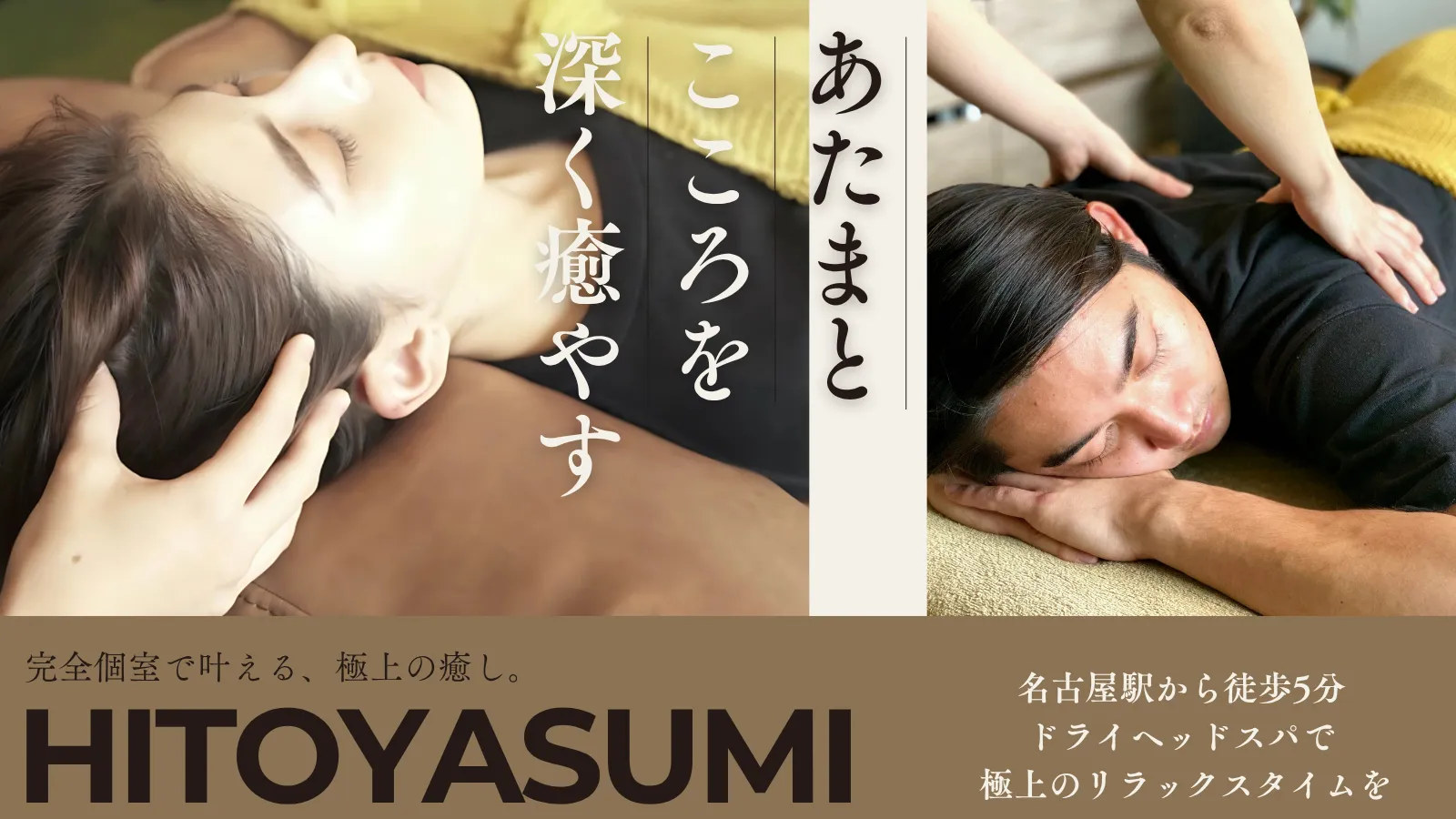
Visit the private-room salon a five-minute walk from Nagoya Station, HITOYASUMI, to refresh your mind after work.
Recommended treatments
Dry head spa (75 min), ¥5,980
Thorough neck, shoulder and décolletage care: a starting point for tension-type headaches.
Head spa & customised care (95 min), ¥8,280
Personalised care for headaches, neck tension and tired eyes.
Dry head spa & back myofascial release (105 min), ¥8,980
Care from head to back for stiffness from a hunched back or rounded shoulders, clearing away desk-work fatigue.
Salon information
Address: THE WHITE OISE 201/301, 5-12 Takebashicho, Nakamura-ku, Nagoya, Aichi
Access: 5-minute walk from Nagoya Station
Opening hours: weekdays 12:00–21:00 / weekends and public holidays 11:00–20:00
Closed: year-end and New Year holidays
Phone:052-898-2851
Reservations: Book online here• Phone bookings
Conclusion
Desk-work headaches and neck tension involve more than poor posture. Muscle over-tension from leaning forwards, tired eyes and mental fatigue combine in complex ways to create persistent pain.
Stretching and painkillers can help, but a fuller reset may need care for deeper muscles and a shift in nervous-system activity.
Before daily headache becomes normal, consider professional rest for mind and body.
A lighter tomorrow begins with a little rest. We look forward to welcoming you.