2025
Mar
08
Text neck in the digital age: easing chronic neck and shoulder pain with dry head spa

Introduction: a new health challenge in the digital age
Smartphones, tablets and computers have become indispensable in modern life. Their convenience gives us information anywhere, anytime, but prolonged device use has also brought growing attention to a new health problem: smartphone neck, or text neck.
In cities such as Nagoya, people looking down at their phones on trains and in cafés are an everyday sight. Long hours of device use place considerable strain on the neck and shoulders, often without us realizing it.
This article explains the mechanisms of text neck, prevention and improvement, and effective care at “HITOYASUMI”, a dry head spa specialist near Nagoya Station, drawing on scientific evidence. If desk work or remote work makes up much of your day, use this information to help care for your neck and shoulders.
What is text neck? Its prevalence in modern society
“Smartphone neck” describes a condition in which prolonged smartphone or tablet use reduces the neck’s natural forward curve and leaves the cervical spine straighter. It is also known as “text neck” or “straight neck.”
The cervical spine normally curves gently forward. Holding the head tilted forward for long periods can cause that curve to diminish and the neck to become straight.
The prevalence of smartphone neck in Japan
Interestingly, an istat survey in 2022 found that only around 70% knew the term “smartphone neck,” suggesting that awareness was still incomplete. Yet about 40% felt they had symptoms, with particularly high numbers among people in their 20s and 30s.
A Sapeet survey published in 2025 reported the following rates of smartphone neck, or straight neck:
- People in their 20s: 55.5%
- People in their 30s: 44.6%
- People in their 40s: 39.8%
- Age 70 and over: 52.2%
The condition was especially common among younger people, but the substantial rate among older adults is also noteworthy. Different factors may be involved: smartphone dependence among the young and age-related changes in posture among older adults.
The relationship with time spent using smartphones
Time spent on digital devices in Japan has been increasing year by year. An NTT DOCOMO survey found that around 70% of women in their 20s and about 47% of men in their 20s reported using a smartphone for at least four hours a day. Such prolonged device use is clearly closely related to text-neck symptoms.
How text neck develops and affects the body
Text neck is more than a posture issue; it can affect a range of bodily functions. Let’s examine how it works.
Neck angle and the strain on your neck
The human head weighs around 4–6 kg, roughly one tenth of body weight. The neck’s natural curve normally distributes this weight, but with straight neck, the head’s weight places a more direct load on muscles around the neck and shoulders.
The further you tilt your head, the more dramatically the load on your neck increases. Research by New York spinal surgeon Dr. Kenneth Hansraj describes the relationship as follows:
Angle | Load on the neck (kg) |
|---|---|
0 degrees | 4.5 - 5.5 |
15 degrees | 12 |
30 degrees | 18 |
45 degrees | 22 |
60 degrees | 27 |
At a 60-degree downward angle, the calculated load on the neck is equivalent to the weight of an average eight-year-old child. Sustaining such excessive loads fatigues neck muscles and gives rise to various symptoms.
Effects on the nervous and musculoskeletal systems
The effects extend beyond muscle fatigue. Tense neck muscles can disturb autonomic balance and make sympathetic activity more dominant, potentially leading to the following symptoms:
- Effects on the nervous system:
Headaches, including tension headaches and migraines; dizziness; tingling in the hands and feet; autonomic disturbances such as insomnia, irritability and fatigue; reduced concentration; and tired eyes.
- Effects on the musculoskeletal system:
Neck and shoulder stiffness; back and lower-back pain; worsening rounded posture; cervical-spine damage; and temporomandibular joint disorders.
Of particular concern is impaired blood flow in the neck, which affects the supply of blood and oxygen to the head and can cause headaches and dizziness. In severe cases, compressed neck nerves may also cause neurological symptoms such as tingling in the arms and hands.
A report from the Department of Orthopaedic Surgery at Tokyo Medical University notes that prolonged, severe text neck may produce autonomic symptoms similar to those seen in whiplash patients and interfere with everyday life.
How to check yourself for text neck
Try these simple checks to see whether you may have text neck.
Everyday habits checklist
First, check whether the following apply to you:
- You spend long periods doing desk work, at least three hours.
- You use a smartphone or tablet for at least one hour a day.
- Tilting your neck backward causes pain or discomfort.
- Your shoulders or neck tend to become stiff while sitting.
- You often have headaches while working or studying.
- You feel discomfort in your neck or shoulders while looking at your phone.
The wall test
For a more specific posture check, try the “wall test”:
- Stand upright with your back to a wall.
- Place your heels, buttocks and shoulder blades against the wall.
- Check whether the back of your head naturally touches the wall in this position.
If the back of your head does not touch the wall, or only touches when you deliberately tilt your neck back, you may have text neck. Another possible sign is that, viewed from the side, your head sits in front of your body’s vertical axis.
Checking severity
The following criteria can be used to assess severity:
Level | Condition |
|---|---|
Mild | The back of the head does not touch easily but does so with a small conscious adjustment. |
Moderate | The back of the head barely touches the wall, but can do so with effort. |
Severe | The back of the head cannot touch the wall, even with effort. |
Signs that you should seek professional advice
See a medical provider promptly if you have any of the following:
- Severe neck or shoulder pain.
- Tingling in the hands or feet.
- Dizziness or nausea.
- Severe headaches.
- Concerns about autonomic disturbances.
- A severe result on the self-check above.
These symptoms may indicate a condition such as cervical spondylosis rather than ordinary shoulder stiffness. Consult an orthopaedic doctor or a practitioner at a Japanese seikotsuin clinic for appropriate care.
Preventing and improving text neck
Because text neck is linked to lifestyle, reviewing everyday posture and habits can help prevent and improve it. Professionals in their 20s to 40s, including Nagoya office workers, can reduce neck strain by keeping the following measures in mind.
Good device posture and ergonomics
Good posture when using a smartphone:
- Raise the device to eye level.
- Keep your back straight and shoulders relaxed.
- Gently tuck your chin.
- Keep your head aligned with your body.
- Hold the device with both hands and keep your elbows close to your body.
Setting up a computer workstation:
- Sit well back in the chair and adjust the height so both feet rest fully on the floor.
- Set the screen at eye level or slightly below.
- Keep your eyes at least 40 cm from the screen.
- For a laptop, use a stand to raise the screen and add an external keyboard.
One posture to avoid is using a smartphone while lying on your side in bed. Prolonged viewing in that position twists the neck unnaturally, places excessive strain on one eye and can adversely affect vision.
Take regular breaks and review your habits
Even when digital-device use is unavoidable, taking frequent breaks can help prevent text neck. To avoid staying in the same position for too long, stand up or stretch every 30–60 minutes to release tension in your neck and shoulders.
The “20-20-20 rule”—looking 20 feet, around 6 m, away for 20 seconds every 20 minutes—can also help rest the eyes and neck. During breaks, gently tilting the neck back or opening the chest while drawing the shoulder blades together can help reset muscle tension.
Reviewing when and how you use devices is also important:
- Limit phone use during commuting and before bed.
- Set specific screen-time periods and use a timer.
- Use blue-light-filtering glasses to reduce eye strain.
- Turn off notifications and check them in batches.
- Use voice input and text-to-speech to reduce time looking at screens.
Simple stretches and exercises
Stretches and exercises that release tight muscles and support weakened muscles can also help improve text neck. Here are selected movements that take little time, at work or at home.
1. Shoulder-blade stretch: opening the chest
- Sit upright in a chair without leaning against the backrest.
- Interlace your fingers behind your head.
- Exhale as you slowly pull your elbows back, drawing the shoulder blades toward the center.
- Take five seconds to pull back and five seconds to return, repeating the movement.
- Keep the chin gently tucked and focus on lengthening the back of your neck.
2. Sternocleidomastoid stretch: stretching the front of the neck
- Slowly turn your face to the right and lift it diagonally upward.
- Place your left hand around the left collarbone, on the side opposite the direction you are facing, and hold the skin in place.
- Tilt your neck a little further backward.
- Hold for 15 seconds while feeling a stretch in the front of the neck.
- Repeat on the opposite side, turning left and placing your right hand above the right collarbone.
3. Chin tucks: training the deep neck muscles
- Sit with your back straight and look forward. Slowly draw only the chin back, as though moving your throat backward.
- Imagine making a “double chin.”
- Hold for five seconds, then return to the starting position.
- Repeat about ten times.
You do not need to do every exercise at once. Even one or two movements during a work break or before bed are enough; what matters is continuing every day.
Using ergonomic products
Consider incorporating ergonomic products that support good posture into your text-neck prevention routine:
- Smartphone stands and tablet holders: hold the device at eye level.
- Laptop stands and external monitors: raise your line of sight and reduce neck strain.
- Ergonomic keyboards and mice: reduce strain on the wrists and shoulders.
- A pillow of suitable height and firmness: reduce neck strain while sleeping.
If you work from home, improve your workstation. Where possible, a standing desk can help you vary your posture while working.
How dry head spa works and its approach to text neck
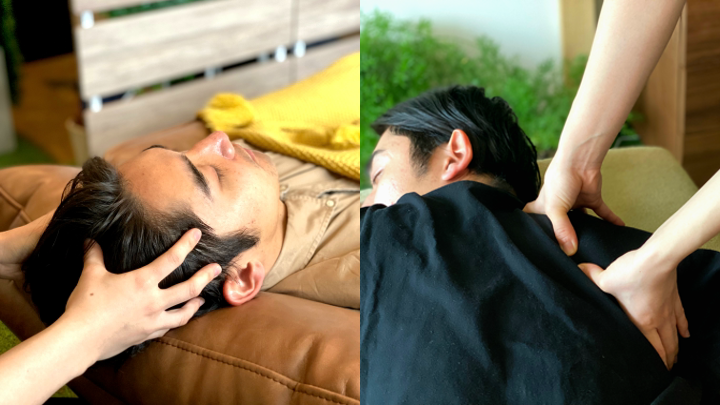
An approach attracting attention in recent years is dry head spa. This hands-on head treatment uses neither water nor oil, and scalp massage helps the brain and body relax.
1. Fascia release and improved circulation
With text neck, muscles that support the head—the trapezius, levator scapulae and sternocleidomastoid, for example—become tense and stiff. By working from the scalp, dry head spa loosens the fascia surrounding these muscles and can, in turn, release neck and shoulder tension.
Because neck and head muscles are connected, careful work at the base of the skull, where the neck meets the head, also helps soften the neck. Many people feel warmth extending to the neck and shoulders during treatment, an indication of increased blood flow.
Better scalp circulation supplies oxygen and nutrients and speeds recovery from muscle fatigue. Softening a tight scalp may also ease a heavy head and eye strain. The sense that the head is lighter and vision brighter after treatment comes from the refreshing effect of improved circulation in the head.
2. Autonomic effects and relaxation
Text neck may be accompanied by headaches, insomnia and eye strain related to autonomic imbalance. Dry head spa can encourage parasympathetic activity—the body’s relaxation response—and produce relaxation so deep that some people fall asleep during treatment.
Scalp stimulation is also said to improve cerebrospinal-fluid circulation, easing tension in the brain and helping it recover from “brain fatigue.” For people whose sympathetic nervous system is constantly activated by modern stress, time spent relaxing the head can bring a calm similar to meditation and offer a powerful mind-and-body reset effect.
Many people report better sleep after releasing head tension and improving circulation, sleeping soundly after treatment and waking with less neck and shoulder stiffness. There are also reports that stimulating muscles and pressure points around the eyes encourages tear production and helps improve dry eyes.
3. Advantages compared with other approaches
Text-neck care includes approaches such as physiotherapy at orthopaedic clinics, massage at seikotsuin clinics and acupuncture. Compared with these, dry head spa offers convenience and comprehensive relaxation.
Head spa is generally received lying down as a relaxation treatment. There is no painful correction, so you can relax throughout. With neither water nor oil, hair is left neither wet nor greasy, making it easy to stop by during a work break or on the way home.
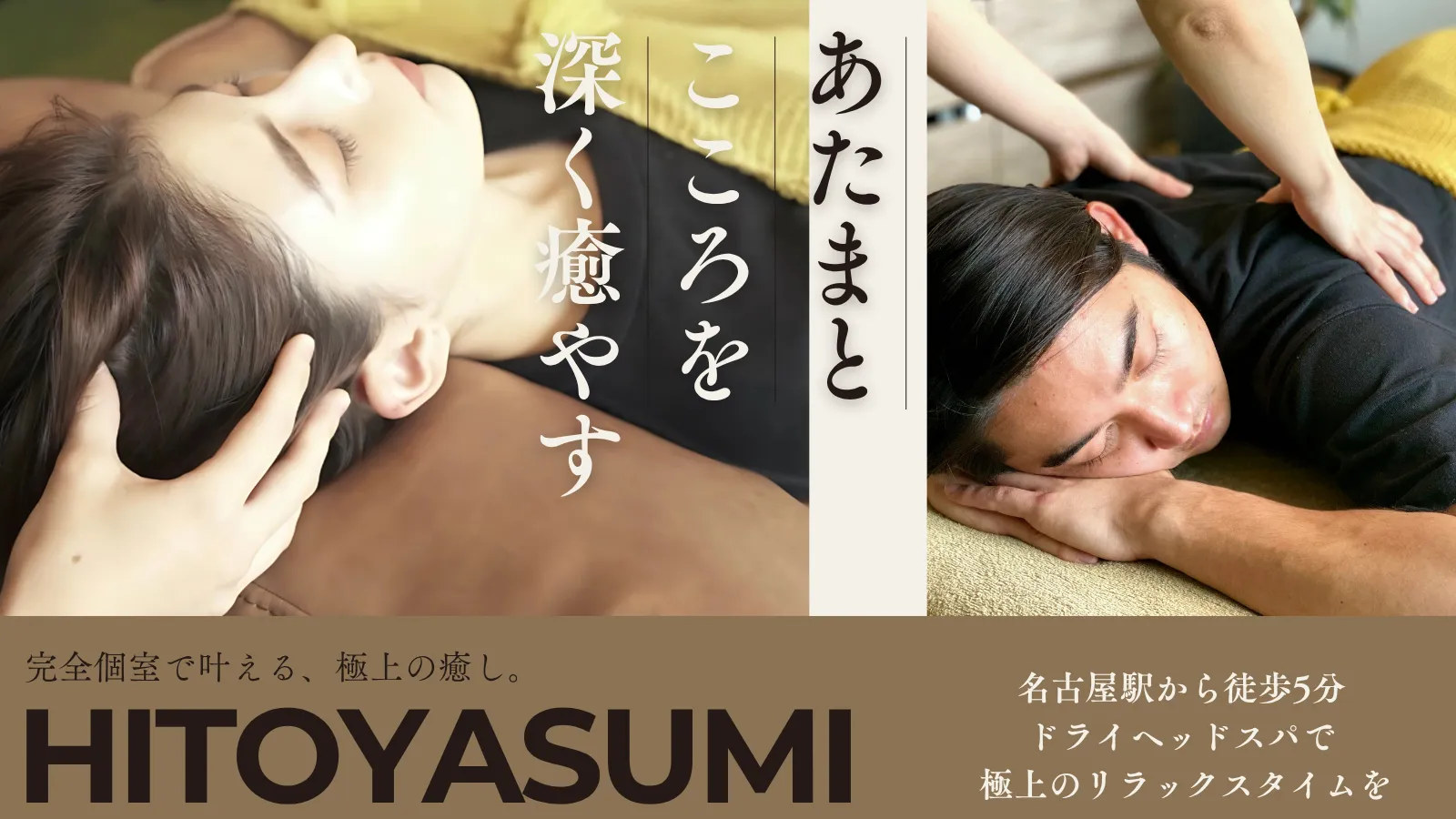
For example, “HITOYASUMI”, a dry head spa specialist that opened near Nagoya Station in 2021, is popular with working men and women in their 20s to 50s. Private rooms and treatment clothes make after-work visits easy. Combining head spa with body care, such as fascia release around the shoulder blades, offers a comprehensive approach to physical fatigue—a heavy head, tired eyes and stiff shoulders—as well as difficulty sleeping.
In this way, dry head spa goes beyond massage to provide comprehensive care for the head, neck, shoulders, mind and body, with the particular appeal of helping busy professionals refresh in a short time.
Treatment frequency and how long effects last
How often should you have a treatment?
The effects of a single dry head spa session gradually fade, making regular care ideal. How long they last varies from person to person, but the benefits are generally said to continue for around one week to ten days after treatment.
For this reason, many salons recommend a treatment once every two weeks to once a month. The scalp’s renewal cycle of roughly four weeks, or 28 days, is another guideline; regular care in step with skin renewal is said to be effective.
For stronger concerns such as shoulder stiffness or insomnia, some salons suggest weekly sessions at first, then moving to monthly care. Continuing at a pace that fits your own schedule without strain is also important.
For busy professionals, once a month may be realistic. Even at that frequency, combining treatment with self-care at home can help prolong the effects. To keep your neck and shoulders relaxed, practice the stretches described above and pay attention to good posture each day.
For example, posture should feel easier to maintain during the first week after treatment. Use that time to practice good posture and help your muscles remember it, and keep up bedtime stretches. Combining treatment with self-maintenance can produce a complementary effect.
In some cases, combining treatment with orthopaedic care or exercise therapy can also help. People with more severe symptoms may use prescribed pain relief or physiotherapy, such as heat or electrical treatments, while receiving relaxation and fascia release through dry head spa, addressing both pain relief and underlying improvement.
Regular care improves flexibility around the neck and shoulders and gradually improves posture, helping prevent text neck from returning or becoming chronic over the long term. Paying attention to your body and maintaining the most suitable frequency is key to sustaining the effects.
Introducing HITOYASUMI, a dry head spa specialist near Nagoya Station
Dry Head Spa & Body Care HITOYASUMI is a specialist salon that opened in 2021, conveniently located five minutes on foot from Nagoya Station. True to its name, meaning “a short rest,” it aims to offer healing time within busy everyday life.
HITOYASUMI's features
- Fully private treatment rooms: a calm environment that respects your privacy.
- Treatment clothes provided: easy to visit after work.
- Welcoming to all genders: a balanced male-to-female visitor ratio of 5:5.
- Customized treatment: tailored to each person’s concerns and symptoms.
- Complete care for the head, neck and shoulders: a connected approach that extends beyond the head to the neck and shoulders.
- Experienced therapists: skilled techniques target and release stiffness.
Text-neck improvement: before-and-after examples
Finally, here are some real examples in which dry head spa and self-care helped improve text neck. Details have been summarized to protect individuals’ identities.
Case 1: a male desk worker in his 30s
Long daily computer work and smartphone use during commuting had left him with chronic neck and shoulder stiffness and tension headaches toward evening. His head did not touch the wall during a posture check, showing a pronounced tendency toward straight neck.
He first reviewed his posture at work, raised his monitor and began standing up every hour. At the same time, he started weekly dry head spa sessions lasting 45 minutes.
After one month, a total of four sessions, neck and shoulder range of motion improved and headaches fell to no more than once a week. Immediately after every session, he felt his head was lighter and vision clearer. From the third visit onward, he also noticed a clear reduction in chronic tightness at the base of the neck.
His therapist also found that the scalp stiffness noticeable by touch at the first visit eased with each session, along with the tension in his neck. He now maintains these improvements with head spa about twice a month and daily stretching.
Case 2: a woman in her 20s working in sales
After the pandemic, she combined remote and office work. More time spent looking at social media on her phone on home-working days brought severe shoulder stiffness, eye strain and light sleep. Her neck felt especially heavy toward evening, and at times headaches kept her awake at night.
On an acquaintance’s recommendation, she tried dry head spa for the first time at “HITOYASUMI” near Nagoya Station. After the first session, she was impressed that her neck felt easier, as if a weight had lifted from her shoulders, and she slept unusually deeply that night. She returned every two weeks and also reduced phone use before bed. As a result, her chronic neck and shoulder stiffness decreased considerably, and she hardly noticed tired eyes or a heavy head after work anymore.
Her therapist attributed much of the improvement to better scalp-to-neck circulation, better sleep quality and a more balanced fatigue-recovery rhythm. She continues monthly head spa as a treat and maintenance for herself, and tries to keep good posture. The severe discomfort she used to experience has not returned.
Conclusion: start addressing text neck today
Text neck affects many people today, but sound knowledge and appropriate measures can help prevent and improve it. In a society where digital devices are essential, adjusting how we use them and how we sit or stand is key to maintaining health.
The main prevention and improvement measures covered here are:
- Maintain good posture: hold devices at eye level, tuck the chin and keep the back straight.
- Take frequent breaks: change posture every 30–60 minutes and stretch the neck and shoulders.
- Make simple stretches a habit: add movements such as drawing the shoulder blades together and chin tucks to your day.
- Improve your environment: adjust monitor position and use ergonomic products.
- Get professional help: use regular dry head spa to loosen fascia and improve circulation.
If you work near Nagoya Station, consider stopping at HITOYASUMI after work to refresh your head, neck and shoulders. Because dry head spa uses no water, you can continue to your next appointment without worrying about your hairstyle.
Above all, what matters is consistency. Beyond one-off measures, small daily habits will shape the health of your neck five or ten years from now. Start gradually with what you can do today, and say goodbye to text neck.
*Information in this article is current as of March 2025. Ask a medical provider or the salon about the latest medical findings and treatment details.
*If text-neck symptoms are severe or persist, do not rely solely on self-care; consult an orthopaedic department or specialist clinic.