2026
Feb
26
Why fiscal year-end fatigue lingers: March self-care and dry head spa for mental rest

Introduction
“The alarm rings, but my body will not move.”
“After 15:00, screen text starts to blur.”
“Even in bed, work plans circle in my head and I cannot sleep.”
Have these experiences become familiar since March began?
This season’s fatigue has medical explanations.
Accounts closing, transfer preparations and farewell gatherings, plus daily temperature differences often exceeding 10°C, make March a time when mind and body can unknowingly use up their energy.
We explain how fatigue accumulates at the end of the fiscal year, and self-care and professional care for a lighter start to the new fiscal year.
Why does March bring a special kind of tiredness?
Temperature swings wear out the autonomic nervous system
March brings alternating cold and warmth, with large temperature changes within a day.
The autonomic system widens and narrows blood vessels to regulate temperature. Large differences keep this adjustment working at full capacity.
It is like keeping the engine running with the accelerator pressed.
This temperature-change fatigue can explain otherwise unclear sluggishness, coldness, stiff shoulders or headaches.
The influence of the stress hormone cortisol
The fiscal year-end rush also places a heavy burden on the brain.
When you face the sustained stress of closing accounts, handovers and managing relationships, your body keeps releasing the stress hormone cortisol.
Persistently high cortisol can make these symptoms more likely.
• Poor concentration(taking 30 minutes for a simple email)
• Reduced memory(more moments of forgetting what you were about to do)
• Difficulty falling asleep(eyes are tired but the mind will not rest)
• Greater irritability(small things unsettle your emotions)
Winter’s fatigue comes due
Another overlooked factor is fatigue accumulated during winter.
In cold weather, the body continually spends energy maintaining its temperature, so immunity also tends to decline. Heading into busy March in that state can feel like running on without enough time to recover.

Mental fatigue: a particular concern for desk workers
Not moving can tire the body
It may sound contradictory, but sitting still for a long time is one of the activities that tires muscles the most.
An hour or more in the same posture tightens neck and shoulder muscles and reduces circulation. Fascia connects them with the scalp, so persistent shoulder tension can also reduce scalp circulation, producing a heavy head or squeezing headache.
Decision fatigue
In March, alongside your regular workload, the number of decisions rises sharply.
Budget allocation, staffing and scheduling keep the prefrontal cortex—the part responsible for thinking and judgement—working at full capacity, overwhelming its ability to process everything.
These signs may indicate a tired mind.
• Judgement clearly declines in the afternoon
• Mentally alert at night but physically unable to act
• Tasks remain in the back of your mind even on days off
• Even choosing what to eat feels impossible
This is not weak willpower but depleted mental energy.
Ways to ease fiscal year-end fatigue, starting today
Food: vitamin B1 for brain energy
A key nutrient for recovery is vitamin B1, helping convert carbohydrates into energy and ease mental fatigue.
vitamin B1…pork, eel and soy foods, supporting energy for mind and body
Allicin…spring onions, garlic and chives; pair with B1 to aid absorption
Vitamin C…citrus and broccoli, helping protect against stress-related oxidative damage
Aspartic acid…asparagus and chicken (help the body eliminate fatigue substances; asparagus is in season in March!)
We recommend pork and chive stir-fry or pork miso soup. Easy to make, they efficiently supply nutrients needed for recovery.
Bathing: warm water at 38–40°C
A hot bath may be tempting when tired, but 15 minutes in warm 38–40°C water is better for autonomic balance.
Overly hot water stimulates sympathetic activity and can leave you more awake.
Another tip is warming three areas: neck, wrists and ankles. The neck, wrists and ankles are pathways for the autonomic nervous system, so simply warming them efficiently improves circulation throughout the body.
At work: a one-minute shoulder-blade reset
Try these simple stretches while seated.
1. Shoulder release
Lift both shoulders as high as you can towards your ears and hold for five seconds, then let them drop completely. Repeat three times to improve circulation and leave the shoulders feeling lighter.
2. Back-of-neck stretch
Interlace both hands behind the head and use their weight to slowly stretch the back of the neck. This is a key way to improve blood flow to the brain.
3. Digital detox: the 20-20-20 rule
Every 20 minutes, gaze softly six metres away for 20 seconds. This alone can greatly reduce autonomic imbalance caused by eye strain.
Why dry head spa helps fiscal year-end fatigue
Self-care is important, but to reset accumulated fatigue at its root, a professional treatment that lets the brain rest can help too.
A shift in autonomic activity in around 15 minutes
Research has reported that appropriate head touch can encourage parasympathetic activity within around 15 minutes.
Heart rate settles, blood pressure stabilises and alpha waves associated with relaxation increase.
Serotonin activity
In an experiment supervised by leading serotonin researcher Professor Hideho Arita, emeritus professor at Toho University School of Medicine, dry head spa produced specific brain-wave patterns indicating serotonergic activity.
Serotonin activity may support
• emotional stability(less irritability and anxiety)
• Better resilience to stress
• normal melatonin release(better sleep quality)
.
The experience of switching a busy mind off
At fiscal year-end, the brain is always “on”: phone notifications, email replies and an endless to-do list.
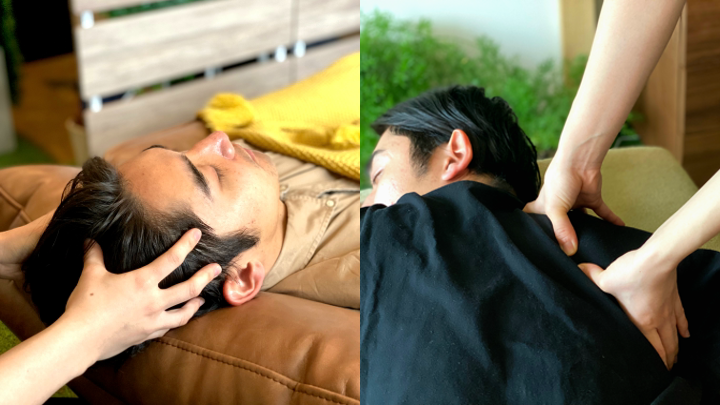
In a dark, quiet setting, dry head spa offers a complete stop to information processing and a forced rest for the brain: a valuable experience for desk workers.
Most guests fall into deep sleep, a sign the body can finally rest.
Frequently asked questions
Q. I am too busy at fiscal year-end to make time.
A. HITOYASUMI’s most popular option is the 75-minute course. Five minutes from Nagoya Station, it can fit after work or into an extended lunch break. A short, deep rest matters precisely when time is scarce.
Q. Can I notice a difference after one dry head spa?
A. Many guests report a lighter head or clearer vision after one visit. Changes can feel particularly noticeable when tiredness has accumulated.
Q. Can men visit?
A. Of course. HITOYASUMI welcomes all genders in a private salon. Many guests are men with desk-work fatigue.
Q. What should I wear?
A. Everyday clothing is fine, including suits. Come straight after work. A change of clothes is provided for courses that include the back.
About HITOYASUMI
There is no need to carry year-end fatigue into April.
Five minutes from Nagoya Station, refresh head, mind and body in a green, completely private space.
Recommended treatments
Dry head spa (75 min), ¥5,980
For an easy first trial, with thorough neck, shoulder and décolletage care.
Head spa & customised care (95 min), ¥8,280
Personalised treatment focused on your areas of concern.
Dry head spa & back myofascial release (105 min), ¥8,980
For those concerned about shoulder tension and a tight back, care extends from the head to the back to address fatigue throughout the body.
Dry head spa & full-body lymphatic care and myofascial release (135 min), ¥11,980
For those wanting care for the whole body. Entirely hands-on treatment supports fatigue recovery and beauty benefits. Women only.
Salon information
Address: THE WHITE OISE 201/301, 5-12 Takebashicho, Nakamura-ku, Nagoya, Aichi
Access: 5-minute walk from Nagoya Station
Opening hours: weekdays 12:00–21:00 / weekends and public holidays 11:00–20:00
Closed: year-end and New Year holidays
Phone:052-898-2851
Reservations: online or by phone
Conclusion
March fatigue reflects how hard you have worked.
Before the engine burns out, take a proper little rest.
Autonomic exhaustion from temperature differences, accumulated stress hormones and an overheated brain: fiscal year-end fatigue has clear causes, and appropriate care can help reset it.
Make self-care such as healthy eating and bathing part of your routine, and seek professional help with accumulated fatigue. This is not indulgence, but “strategic rest” to maximise performance from April.
Start the new fiscal year feeling lighter.
Enjoy a wonderful little rest at HITOYASUMI.